Showing posts with label Lutheran. Show all posts

Wednesday, October 31, 2012

Reformation Day


Today is known by many as Reformation Day.  This is on account of an event that occurred 495 years ago on October 31, 1517.  On that day, a relatively obscure monk and doctor of theology posted 95 theses concerning abuses within the Church of God, or at least what people had been taught to believe was the Church of God.  The truth is that the Church had been taken captive by a larger body that was really not the Church at all.  Yet within this larger body, God had preserved a few who miraculously still clung to the promises of God in Christ, though they were terribly persecuted whenever they dared to speak openly concerning these things.

Dr. Luther wrote his concerns in the form of the famous, or infamous in some circles, 95 theses and he posted them on the community theological bulletin board, that is, the door of the Wittenberg Church.  His intention was to begin discussions regarding what the Holy Scriptures declare for the Church, especially in contrast to the posted abuses.  From this grew a mighty firestorm as the validity of these challenges became apparent to more and more theologians and people.  This reaction to Luther and his challenges, which grew to become a movement throughout the world, became known as the Protestant Reformation, and that which remained closer to the doctrine exposed by Dr. Luther and his fellow theologians was more narrowly labeled the Lutheran Reformation.

Having shared this background information, it is fitting to ask a larger question: “What is Reformation Day really about?”

If a house is handed down within a family from generation to generation, there could be a number of occasions for celebration regarding this house.  One occasion for celebration could be the day of the purchase of the land.  Another could be the day of first breaking ground for the laying of the foundation.  Another could be the day of completion of the building.  Another could be the day the family actually began to reside in the house.  If a loan or mortgage was involved, the day of the payoff could be another occasion.  The birth of the first child could be another.  On and on the occasions for celebration multiply.

Perhaps the house caught fire and burned in the seventh generation and had to be rebuilt.  This would become yet another occasion, one that may even encompass many of the previous occasions and combine them all into one great celebraton.

Reformation Day is much like this.

However, if such an occasion were to be celebrated in perpetuity, would those who enjoyed the benefits of the house make one of the tools the focus of the celebration?  Would they make the focus the pick axe that was used to break the ground?  Would they choose the saw that made the first cut in the new timber for rebuilding the burned house?  Moreover, would they name the house after the pick axe or  rename the rebuilt house after the saw?

Does this sound ridiculous?

What is the Reformation really about?  Is it about the tool, Luther, whom God used to call out His children from a burned out and crumbling house?  Or is it about the house of God to which He called out His children and the joyous and blessed life within this house that He provides for all who hear His calling and gather to the means of this blessed life?

Moreover, what is the house of God, anyway?  Is it the building upon which people place their signs after they erect their stones or bricks or lumber?  Is it the corporation that they charter and define with a constitution and bylaws?

Did Luther and his brethren who stood with him in the face of threats against their lives and persecution of many kinds have anything to say on this?  Did they give a clear definition of what they believed the house of God, the Church, to be?

Indeed they did.  They spoke of this in the confession of faith that they were required to present to the Emperor in 1530 at the Diet of Augsburg.  This has come to be called the Augsburg Confession.  Within this confession many of the articles of the faith are addressed, stating what these churches and teachers who stood together in concord believed, taught, and confessed from the Word of God.


Article VII: Of the Church.


1] Also they teach that one holy Church is to continue forever. The Church is the congregation of saints, in which the Gospel is rightly taught and the Sacraments are rightly administered.
2] And to the true unity of the Church it is enough to agree concerning the doctrine of the Gospel and 3] the administration of the Sacraments. Nor is it necessary that human traditions, that is, rites or ceremonies, instituted by men, should be everywhere alike. 4] As Paul says: One faith, one Baptism, one God and Father of all, etc. Eph. 4, 5. 6.

Article VIII: What the Church Is.

1] Although the Church properly is the congregation of saints and true believers, nevertheless, since in this life many hypocrites and evil persons are mingled therewith, it is lawful to use Sacraments administered by evil men, according to the saying of Christ: The Scribes and 2] the Pharisees sit in Moses’ seat, etc. Matt. 23, 2. Both the Sacraments and Word are effectual by reason of the institution and commandment of Christ, notwithstanding they be administered by evil men. 3] They condemn the Donatists, and such like, who denied it to be lawful to use the ministry of evil men in the Church, and who thought the ministry of evil men to be unprofitable and of none effect.


Do those who celebrate the Reformation today share with these confessors of the Faith the same understanding?  Do they celebrate what the “Reformers” celebrated?

What really is the cause for celebration this day?

Is it not that God worked through various men throughout the many generations to proclaim His saving Gospel and to administer His Sacraments for our salvation and preservation as His children within His holy household of faith?  When we celebrate Reformation Day, is not the true cause for celebration the gifts of the Gospel and the Baptism by which God regenerates us as His true children and the Holy Supper by which He nourishes us with His forgiveness and renewal in the one true faith in His Holy Communion?

How many times does the Lord Jesus emphasize the fact that the Gospel is the call of the King to all of His scattered children to be gathered to the wedding banquet?

Is this not the true focus of Reformation Day?

Is this gracious activity of the Lord our God not true cause for celebration?

+ + +

Saturday, October 27, 2012

Christian, Lutheran, Whatever, What ARE You?


A blog that I sometimes visit is Worldview Everlasting.  When I first stumbled upon this blog I was fascinated by it.  Over time I became aware of the cause of my uneasiness with this “Lutheran” and his “style” and the compendium of topics and contributors.  Now I visit the site occasionally just to see whether things have moved in a more helpful direction.  My visits are becoming less and less frequent, due to the continual disappointment.

One of the recent video posts is All Ur Labels R Belong to Us.

The very title, with its world-mimicking bad grammar and style, makes me squirm.  It immediately sets off the holy alarms in my spirit and soul.  It is akin to the feeling of having a caterpillar or other creature crawling down my neck inside the back of my shirt.  Sometimes this sense is more like the feeling of having bird poop fall on me from overhead.  Other times it is like the sense of feeling my foot slip when I step upon a fresh pile of doggy poop in someone’s back yard.

The immediate sense is that something is not right.  Something is out of place.

Such senses should not be ignored in life.  The warnings are genuine.  They are signals that one should be alert and on guard.

These uneasy sensations are the natural response to things that do not fit, things that are not honest and true.

In the case of these titles of video posts, they do not fit with the manner of what the blogger claims to represent.  This is not the norm for the one holy catholic Church that is called, gathered, enlightened, and sanctified by the Holy Spirit and kept with Jesus Christ in the one true faith.  This simply is not the way of those who are called out of the world to stand apart from the world.  This is not the way of those who live in the world but are not of the world.

Read the Scriptures and see.  Does the Lord conform Himself and His ministry and preaching to the style and manner of the world?  Do His apostles preach or write in this way?  Do they try to incorporate the modern lingo and mannerisms so as to try to make themselves more appealing?

The Scriptures do speak of those who use this approach.  What the Scriptures say concerning this way is not flattering.

In the video post listed above, All Ur Labels R Belong to Us, the content matches the style.  It is consistent with the overall approach of the web site.  It tries to blend the world’s view of reality or the “worldview” with the view of the Church with the catchy title of “Worldview Everlasting.”  It sounds very spiritual.  It sounds very “other-worldly.”  But it is really very worldly in the end.  It is a reduction of “the things above” to acceptance in terms of things below.

This is demonstrated powerfully in the following portions of this video post.

On the time line, at 4:16, a question from a commentator is shared.
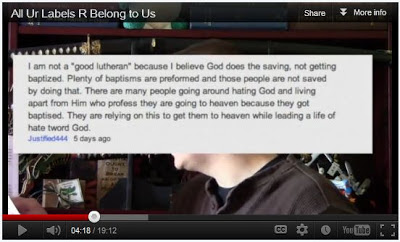


At 4:26, Fisk addresses this.


Here Fisk identifies the problem with Lutheranism, including his definition of Lutheranism.  The problem is one of dishonesty and total lack of integrity.

Notice the statement in the center of this where Fisk replies, saying:


     You are not a Lutheran - which is fine, so long as you are honest about it.


This is a recurring doctrine throughout this video post.  It flows throughout the entire blog and its many posts.

At 5:14 Fisk says in this video,


     Be what you are.  Love what you are.  If you believe something, embrace it. . . . I’m not trying to put you in a hole, I’m just trying to get you to, you know, enjoy what you actually think.  Embrace it!


Is this what the Lord Jesus teaches?  Is this even remotely like what the apostles teach?  Do the Scriptures ever say this?  Or do the Scriptures actually declare that we should hear the truth and be turned from what we are and what we think and what we construct for ourselves?

Do the Scriptures ever declare that it is OK to believe what we want so long as we listen to what others say and accept them for who they are?

Is this the way of the Holy Scriptures?  Is this what is exposed in the “Lutheran Confessions” that Fisk claims to believe and confess and teach?

Do the Lutheran Confessions say that it is OK to love and embrace the ways of Wesleyan Baptist theology and practice?

At 9:12 Fisk says:


     But if your ism happens to be Lutheranism, which basically has six chief things, there’s like six things that make a Lutheran, we call them the six chief parts, and we believe they’re actually six things that make you a Christian, too, although you can be a Christian without believing everything about every piece of the chief parts, but they are the fullness of Christianity and they all point you back to Christ and the cross, but pretty much to deny any of these six things, I mean, it’s not like it’s this big giant list somewhere, it’s six stinkin things, right, you believe these six things and you are a Lutheran.  You don’t believe these six things and you’re not a Lutheran.  We call these six things the Small Catechism, because it is rather small, and catechism means: “teaching.”  It is just the small list of teaching that actually makes you Lutheran.

     I don’t define this.  I mean, where do you get off accusing me of that?  As if it is my idea.  You think I’m making this stuff up?  You think it’s about me?  If you think it’s about me, you just got to watch these videos a lot more, because you know, go back and watch the old ones.  This sucker aint about me man, this sucker’s about the Word of God.


Do people who speak this way ever even listen to themselves so as to hear the amount of double-mindedness that is expressed in their preaching?

For openers, where does Lutheran doctrine ever speak of Lutheran Christianity?

Hmm?

Where do the Lutheran Confessions ever speak of anything other than the one holy catholic/universal/Christian Church?

How can Fisk say, “they’re actually six things that make you a Christian, too, although you can be a Christian without believing everything about every piece of the chief parts”?

How can he say two diametrically opposing things within the same sentence and not hear the fallacy?

How can people listen to this and accept this as genuine?

How can he furthermore refer to the six chief parts of the one true faith by which God’s grace is declared and taught and imparted as “six stinkin things”?

Is this the way of someone whose first thought is to proclaim the truth of God’s Word, or is it the way of someone who is more concerned about sounding cool?

If these six chief parts are what make a person a Christian, how is it possible not to believe everything about them without losing one’s Christianity?

Does a baker accept this notion regarding the ingredients for a cake or a loaf of bread?  Does a mechanic say this regarding the parts of an engine that is being reassembled?  Does an electrician say this concerning the wiring of a house?

Would you trust any of these if they did?

How can Fisk make such statements while demanding integrity and honesty of others?

How can Lutherans in general follow this way as most do today?

The answer rests at least in part with the rest of what Fisk says about these six chief parts.  He says that we call them the Small Catechism.  He makes this false statement because he is falsely focusing upon the “smallness” of the essential and necessary parts of the Christian faith.  He is attempting to minimize the content of the doctrine that must stand as what is believed.

What does Luther and the catholic Church call these six chief parts?

The Catechism, is what they are called.

The so-called Small Catechism is the smaller and more concise of Luther’s explanations of the Catechism.  Luther wrote a Small Catechism in which the six chief parts are briefly explained so that the simple and young could understand them.

Luther also wrote a Larger Catechism in which he expanded his explanations of the Catechism or the Six Chief Parts more extensively.

Something that Luther does not say concerning these six chief parts is that anyone ever may dare to deny them in any part.  To deny these in any way, to reject so as not to believe any portion of these, is to deny the Word of God Himself, to deny Jesus, and to lose one’s salvation.

Luther treats this very seriously.  He never speaks of those who reject the efficacious nature of Baptism as true Christians.  He never speaks of those who deny the body and blood of Jesus in the Sacrament as true Christians.  Rather, he warns them against eating and drinking judgement upon themselves and cutting themselves off from God’s Holy Communion.

But Fisk and nearly every Lutheran today mocks this, saying that a person can be a Christian while denying and refusing to believe what Jesus and His apostles plainly declare.

The Christian faith, the faith by which salvation is imparted by God to those who stand desperately in need of being saved, is an “All or Nothing” faith.  It cannot be divided into portions that are necessary and unnecessary or even less necessary.

As an arborist who climbs trees using ropes for my own positioning and safety as well as for securing and lowering tree limbs and controlling the felling of trees in dangerous situations, I have come to value a saying by Clifford Ashely:


     A knot is never nearly right; it is either exactly right or it is hopelessly wrong, one or the other; there is nothing in between.


This saying is exemplified in the following explanation from “Tie, Dress, and Set (TDS)” in “The Tree Climber’s Companion.”


     Tying knots involves more than just making the “rabbit come out of the hole, go around the tree, and back in the hole” as with the Bowline. A properly tied knot must also be finished properly by dressing it and setting it. Dressing the knot means properly aligning, arranging, or straightening all the parts of the knot so it matches the description and picture in the book. Knot and rope strength can be significantly reduced if the knot is dressed improperly.

     Setting the knot involves tightening all its parts so they properly touch, grab, and press against each other. This creates friction on the rope—the reason a knot works.  A knot that is loosely tied could “capsize” and come untied when a load is applied.  It is good practice to periodically inspect knots while in use to ensure they remain tied.  New knots should never be employed aloft until they can be skillfully tied, dressed, and set (TDS) while on the ground.


From this it is easy to recognize the absolute importance of 100% accuracy in the doctrine of knot tying.  It also is easy to see that one must believe all aspects of this in order for the doctrine to have its effect in practice.

For example, a knot that is tied correctly will not hold if the person does not believe that it must be properly set and therefore skips this absolutely necessary step.

The same is true concerning the Six Chief Parts of Christian doctrine.

No part can be ignored or rejected if the doctrine is to be effective.

God does not give His doctrine without purpose.  He does not teach things that are not necessary.  All aspects of the truth are necessary.  Any departure from the truth is a departure from the truth.

This should be committed to heart, mind and soul.

Any departure from the truth is a departure from the truth.


If one does not hold to this, what difference does it make whether or not one is “honest” about being a Lutheran?  What does it matter if the article of doctrine concerning Baptism can be rejected and one can still be Christian?

The reason that the many imagined Lutherans think that it is important to be Lutheran is that they are actually promoting themselves.

One of Shakespeare’s famous quotations is from Hamlet:

"The lady doth protest too much, methinks."

Lutherans often fall into this category, as Fisk seems to protest too much when he says,

     I don’t define this.  I mean, where do you get off accusing me of that?  As if it is my idea.  You think I’m making this stuff up?  You think it’s about me?  If you think it’s about me, you just got to watch these videos a lot more, because you know, go back and watch the old ones.  This sucker aint about me man, this sucker’s about the Word of God.


If it is not about “being Lutheran,” why do they protest so much?  Why do they not simply proclaim the doctrine of the true faith as absolutely necessary and stand upon this?  Why do they insist on the name of “Lutheranism” and their church bodies?

God says many times and in various ways, both through the ministry of His Son and through the ministry of His apostles, “Baptism saves you.”  (For example: 1 Peter 3:19-21)

If someone says that this is not true, what does that person say of God, of God’s Word, of the Scriptures, of the faith declared in the Scriptures, of the Holy Spirit who inspired men to write these Scriptures, of the men who wrote them and proclaimed them, and of the Church?

If one says that what God says is true but that one can be a Christian while saying that what God says is not true, what does this mean?

Why even bother preaching and teaching concerning these things at all?

Unless of course, it really is about you after all.

Whose word really matters?  In whose words do you really trust?

Hmm?

Romans 3:4

+ + +

Tuesday, October 02, 2012

Ephesians 4 versus “Lutheran Christians”


     It seems that almost anywhere that a person turns in search of those who profess to be Lutherans that a very anti-Lutheran identity is encountered.  It seems that even amongst those claiming to be the most unabashedly Lutheran a very anti-Lutheran identity is professed.

     This term has become very common among those professing to be Lutherans and especially among those who present themselves as “defenders of the faith.”  They commonly refer to the importance of the historic liturgical practice.  They generally refer to the importance of the Lutheran Confessions, even quoting from them, and especially from Luther’s Small Catechism, sometimes from Luther’s Large Catechism, and also even from the Augsburg Confession and the rest of the documents compiled into the Book of Concord.

     Yet even while writing articles and papers regarding the importance of faithfulness to the doctrine and practice tabernacled within these Confessions, even while waxing eloquent in expressing how this doctrine and practice is truly the exposed Word of God as revealed in Holy Scripture, they then apply a term that completely undermines and denounces all that they have written and confessed and proclaimed.

     What is this term?

     Lutheran Christians.

     This self applied identity is anti-Lutheran.  It is, actually, anti-Christian and anti-Scriptural.

     But if one is so bold as to try to explain this to anyone who identifies oneself with this identity and with the identity of one of the larger Lutheran churches, beware!  Stoning could be the result.

     The Lutheran Confessions that the various so-called Lutheran bodies claim to embrace openly and boldly and uncompromisingly declare that such an identity is not of God and not in accord with the Holy Spirit’s revelation of the Word of God through the Scriptures.  In fact, the so-called Lutheran Confessions never even use the term Lutheran.  This came later as people began to depend upon the presumed faithfulness and power of their churches rather than the means of grace.  The use of the name of Lutheran became a way of pretense.  It became an identity that lost its original meaning and became just a trademark or brand of Christianity.

     Today this has become so pronounced that no one really even considers it anymore.  And so pastors and people alike refer to themselves and especially their churches as “Lutheran Christians.”  This is done in an attempt to justify their special niche in the realm of Christendom.  Since it is not counted as loving to proclaim the Scriptural doctrine of One Holy Catholic Church with a clearly defined identity that excludes all who create alternative identities, a very broad and loosely defined Christianity is applied to all, with idiosyncratic attributes and identities to various schismatic groups.  When the term “Lutheran Christians” is used, this schismatic or denominational view is what is being embraced and taught and professed.

     This is anti-Christian.  It is anti-Scriptural.


     I therefore, the prisoner of the Lord, beseech you that ye walk worthy of the vocation wherewith ye are called, With all lowliness and meekness, with longsuffering, forbearing one another in love; Endeavouring to keep the unity of the Spirit in the bond of peace. There is one body, and one Spirit, even as ye are called in one hope of your calling; One Lord, one faith, one baptism, One God and Father of all, who is above all, and through all, and in you all.  (Ephesians 4:1-6)


     Here St. Paul teaches with absolute clarity that there is complete unity in the body of Christ, the Church.  This unity is said to be ONE body.  St. Paul addresses this with extremely strong chastisement to the Church in Corinth.  He plainly teaches them that they have ceased walking as one and that they have created divisions that result in extreme forms of idolatry.  He addresses the Church of God in Corinth, because this is who they were called to be.  A few still remained in that but were allowing divisions or denominations to exist and still be called the Church.  He called them to be turned again together to the true faith and to abide in the way of the truth in absolute unity.

     To the Ephesians the apostle declares that there is ONE body.  This is because there is only ONE Spirit, the very Spirit of God who called them to their vocation as saints in the Communion of God in Christ.  There is ONE body, ONE Spirit, ONE hope.

     He proceeds to explain that there is ONE Lord, ONE faith, ONE baptism.

     There are not multiple Lords who proclaim different doctrines and practices.  No, there is one Lord, who generates us all through one faith in connection with one Baptism.  There are not multiple definitions and confessions of faith.  There are not multiple ways of understanding Baptism and what God works through Baptism, just as there are not multiple Lords or multiple Gods.

     Yet there have been designed and declared multiple bodies and multiple Lords.  Jesus, the Lord, has only one body, yet self-identified Christians have presumed to divide the body of the Lord.  They have divided in their imaginations the Lord Himself.  Some say that 1 Peter 3:21 is not true and is not to be believed, saying that Baptism does not save, while others imagine that the mere action of baptizing apart from the regeneration and renewal of the Holy Spirit can save.  Some say that a person can cause oneself to be “born again” or “regenerated” by one’s own choice and decision rather than being the sole gift and work of God.  Some say that the means of grace are merely symbolic and not actually efficacious.  On and on the variations go.

     Then there are the “Lutheran Christians” who say that they stand apart without standing apart.  They acknowledge those who say that Christ does not mean what He says regarding Baptism and the Holy Communion, saying that they are Christians, but merely erring or misunderstanding Christians.  Yet these divisive alternatives have existed for centuries and those who embrace them do not repent of these so-called misunderstanding even in the face of clear declarations from the Scriptures.

     This being the case, what do “Lutheran Christians” really mean by this term?  What faith are they declaring and confessing and embracing?  What Lord do they confess?  What body do they confess?  What Spirit do they confess?  What Baptism do they administer? What Supper do they administer?

     When a group of Lutheran Christians gather as a body, what body are they?  Within the various so-called Lutheran bodies, often even within the same congregation, there are multiple forms of worship, labeled as Traditional, Less Traditional, Liturgical, Less Liturgical, Contemporary, Rock, Jazz, Praise, and Blended.  These various worship forms and styles teach and practice different understandings of what it means to be the body of Christ.  They create multiple versions of Christianity under the facade of unity.

     This being the case, to what body are they really gathering?  In what body are they trusting that they are the Church?  It is the body that they have created through a corporate charter.  It is a business that markets Christianity under various definitions and forms, but lumping them all together as though the distinctions do not matter.

     This is what enraged the Lord Jesus when He encountered it in the temple courts so that He drove out the marketers of Church from the temple.  But that temple is no more.  Now the Church gathers as one body in various places and times, often as a mere two or three saints who have been drawn together into the name of Jesus through Baptism to partake of the pure means of grace together.  They are gathered not by their own decision or choice, but by the Holy Spirit who leads them to crave that which the Lord has promised and ordained for their everlasting unity and safety in His Holy Communion.

     The big bodies refuse to offer this.  They despise those who count the pure means of grace as the only defining characteristic of the true Church.  The big bodies urge devotion to their corporate structure and define evangelism and the work of the Church as maintaining this identity in the community.  And so they establish internal banking systems such as LCEF, that is, Lutheran Church Extension Fund, and teach people that by using this investment banking system that they are promoting the extension of God’s kingdom through the building of structures upon which signs are erected that declare buildings to be the Church.

     Because people have invested their treasures in these buildings and in the corporations that own these buildings, this becomes their definition of Church.  They then become enslaved to these as their God in which they trust.  Jesus warned that where one’s treasure is, there one’s heart is also.

     Thus people continue to look to their corporations and despise those who humbly and meekly are drawn to gather in unadorned places without pomp and grandeur, simply clinging to the pure means of grace as their identity and hope.

     It is quite common to encounter people who say in response to this, “I do not believe in organized religion.”

     This response is understandable considering the mass hypocrisy that exists throughout Christendom.  Yet this response is illogical, for religion is by definition organized.  The question that needs to be considered is who is the organizer?

     The Scriptures declare a very clearly defined religion.  And yet the Church of this religion is not at all complex.  Neither is it confusing.  Neither is it hard to maintain in unity and purity.  It is defined by its Creator as the gathering or flock or assembly or congregation that the Holy Spirit gathers to the pure preaching of the Word, which produces the pure administration of the Sacraments of Baptism, the Lord’s Supper, and the Confession and Absolution offered in connection with these.  Where these are rightly administered and people gather in humble unity of the faith to receive them, there the Church is.  Here poor and rich, Gentile and Jew, man and woman and child, slave and free, all gather as one and rejoice in God’s goodness together.


+ + +

Tuesday, August 30, 2011

Confessional Subscription


Does it seem like the churches today who claim to embrace a Confessional Subscription understand this in like manner to a magazine subscription? Do the churches who claim to subscribe to the Confessions of the Evangelical Lutheran Church treat their Confessional Subscription like an old subscription to a magazine that upon delivery by the postal carrier is then tossed onto a dusty stack? Do they perhaps dust off the stack from time to time to show others how big their stack is?

A recent post on a “Confessional” blog of a prominent clergyman leaves a person wondering just this. In fact, one of his loyal readers responded with a gentle challenge, which was guffawed and brow beaten into submission.

The post is actually copied and pasted from another blog and then praised as a wonderful example of true Lutheran confessionalism. It is a portion of another translation/edition of CFW Walther’s Church and Ministry.

Isn’t that grand? Isn’t that splendid? Yet another edition of Church and Ministry, as if one translation into English was not sufficient. And with all of the English translations of the Book of Concord, that was translated again not long ago, too. Wow, the Concordia Triglotta and the Jacob’s Edition and the Tappert Edition and the Kolb Edition were not sufficient!

Now the new president of the Lutheran Church — Missouri Synod has shown how devoted he is to the faithfulness of the LC-MS fathers and has shown how truly scholarly he is by producing another translation of Walther’s Church and Ministry. The portion that is posted by President Matthew Harrison on his blog Mercy Journeys with Pastor Harrison is entitled, ““Missouri's Position on Intercommunion - Warning! Strong Lutheran Content!” This is copied and posted by Paul McCain at “The LCMS Position on Intercommunion: WARNING – STRONG LUTHERAN CONTENT.”

McCain introduces it, saying:

From the president of The Lutheran Church—Missouri Synod, Pastor Matthew Harrison, via his blog site. Pastor Harrison is providing the Missouri Synod with a new edition of C.F.W. Walther’s Church and Ministry, this is from his revised translation.

In the Comments section the following comments were shared:

From Jeff K:

Kind of a jarring juxtaposition to the immediately preceeding post where you heartily commend us to listen to Dr. Albert Mohler, a Baptist. Last time I checked Baptists denied the Real Presence in the Lord’s Supper and Baptismal Regeneration.

McCain responds:

Insert face palm here.

I invited you to listen to an academic lecture, not to take communion with him.

Good grief.

Then after a supportive comment from an ELCA pastor Jeff K responds:

OK, I figured that you would draw a distinction between a lecture and Communion, and I hope that you would continue to post good things that you hear from Dr. Mohler. May God have mercy on all of us who call on His Name but for conscience sake are not able to share His Supper with each other on this side of heaven. @ptmccain

I offered a comment in which I encouraged Jeff K not to abandon his very valid challenge, and the ever fair and magnanimous and open McCain deleted my comment. Imagine that!

Jeff’s question or challenge is a valid concern. McCain’s answer is typical of the modern understanding of Confessional Subscription. “We hold to a quia subscription to the Lutheran Confessions. We hold them to be true expositions of God’s Word and we treasure them! Just look at how many translations we have made!”

But did McCain even read what Jeff did? Jeff noticed and responded both to the statement by Walther as well as Walther’s quotation from the Apology of the Augsburg Confession from the Book of Concord that Walther boldly quotes and Harrison translates.

First the statement of Walther:

B. Every believer for the sake of his salvation must flee all false teachers and avoid fellowship [Gemeinschaft] with heterodox congregations [Gemeinden] or sects.

Next the quote from the Apology:

2. Witnesses of the Church in Its Official Confessions
Apology: “Nevertheless, we should not receive or listen to false teachers, for they no longer stand in Christ’s place [Christus statt] but are antichrists [Widerchristi]. And Christ clearly commands [befohlen] us regarding them: ‘Beware of false prophets’ (Matt. 7:15). And Paul [writes] to the Galatians: ‘If anyone preaches any other gospel to you, … let him be accursed’ (Gal. 1:9)” (Ap. VII/VIII [IV]. 48; German text, Triglot, pp. 242–43; Mueller p. 162; BSLK 246.20f.).

Let’s see if we can decipher what Jeff must have misunderstood.

Walther says: “Every believer for the sake of his salvation must flee all false teachers and avoid fellowship with heterodox congregations or sects.”

What does McCain say? “Insert face palm here. I invited you to listen to an academic lecture, not to take communion with him. Good grief.”

What does the Apology say? “Nevertheless, we should not receive or listen to false teachers, for they no longer stand in Christ’s place but are antichrists.”

So McCain encourages people to listen to lectures from those whom the Confessions to which he boldly and loudly subscribes say we should not receive or listen to. The Confessions say that such teachers have nothing good to say because they are antichrists. McCain says, just listen but don’t take communion with them.

Jeff says: “Huh?”

McCain says: “Good grief.”

McCain is in agreement with President Harrison. Yet both actually do commune with them as well. Both are in communion with the pastors and congregations of the LC-MS, most of which practice open communion where people who have not even been baptized frequently are communed.

How do I know this? I have read the communion statements of LC-MS congregations where this is what they themselves declare as their practice. I also have spoken with people who are not members of these congregations, who have not been baptized, who do not have any substantive understanding of the faith, who have no idea what the Sacrament is, yet they commune regularly from the hands of smiling LC-MS pastors.

Yes, these people have been some of my customers. Yes, I talk to my customers about what they believe and where they go to church and how they understand the Sacraments. The LC-MS pastors who claim to be so caring and loving and welcoming don’t talk to them about these things, but their arborist does.

So why bother quoting Walther on this issue? Why bother translating the Confessions and quoting them?

What is the point?

It brings to mind the many road signs that say, “Right lane closed ahead.” Which is translated by somewhere between 45 and 85 percent of the drivers, depending on the length of the line:

“Stay in this lane until it runs out and then force your way into line ahead of your neighbors who have respectfully merged and waited their turn.”

It also brings to my mind the many times the same sign has been left posted for weeks after the road work has been completed.

Why do men like McCain and Harrison make so much noise about their Confessional Subscription? Why do they go so far as to translate such things anew and post them for everyone to read, and then deny the meaning of the words when someone asks?

Do you know why? Can you guess?

† † †

Sunday, May 29, 2011

But that would be Works!

In a conversation that was related to me, a person was confronted with performing an action that a Spirit guided conscience would demand, and the person responded saying, “But that would be Works!”

As you may have guessed, this person is a “Lutheran.”

The response was both asinine and disingenuous. It was deliberately used to hide the person’s desire to ignore what this person knew was good and godly and in keeping with the walk that is in the Spirit. The issue was clearly one of following one’s conscience regarding the true faith, yet the person responded as though doing as the Spirit of God leads one in one’s conscience would be an act of works righteousness.

Contemplating this caused me to ponder the state of Lutheranism in this day. Have Lutherans turned the avoidance of dependence upon works righteousness into an act of works righteousness? Have Lutherans taken the right understanding that no one can be justified before God by works of the Law and turned this into a new form of self-righteousness and justification by works? Have Lutherans imagined that they are righteous through the work of believing that they are not righteous by their own works?

As ludicrous as this sounds, it does seem to be what has happened in many cases.

Moreover, have Lutherans used this as an excuse for not doing what they know is right and true? Have Lutherans claimed to be avoiding the false belief in salvation through their own reason and strength as an excuse for not rightly using the reason and strength that God gives to them?

† † †

Saturday, May 15, 2010

WELS & LC-MS once one?

Today I read the following question on my Facebook page:


Question for LCMSers (pastors, laymen, whateva). Since the WELS and LCMS were in fellowship at one point, wouldn't that mean that the LCMS at one point agreed with the WELS views of fellowship, women's suffrage, and the Office of the Ministry? I'm wondering whose position changed, if any?


The answer may be that both changed, but not so much on these issues, but more on how much heterodoxy matters.  The WELS determined that heterodoxy matters just a little more than the LC-MS determined.  Even this is not accurate, it would be better to say that for the WELS their claim to orthodoxy mattered more than with the LC-MS.  The WELS counted themselves more orthodox than the LC-MS had become.

To understand the significance of this one needs to read what Francis Pieper teaches on this matter in his “Christian Dogmatics”, the long-standing standard doctrine textbook for seminarians in the two synods.  In volume III, beginning on pg. 422, Pieper defines orthodoxy and heterodoxy.  He condemns heterodoxy and insists that it must be avoided.  Then, however, he allows that the heterodox communions can be called “Churches in so far as they still retain enough of the Gospel of Christ that men can come to faith in Christ and thus can become true children of God.”

For both the WELS and the LC-MS, following this understanding of Church and fellowship/communion, the issue is not one of orthodoxy versus heterodoxy, but rather it is a matter of better or worse.  Who is the better Church is the question.  Are they good enough that we can tolerate them?

True unity in the faith was not really the issue.  The real issue was that the LC-MS had moved a bit too far for the WELS to tolerate.  (The LC-MS did the same with the ALC.)  The WELS did not cease calling the LC-MS a Church.  Neither did they cease calling the LC-MS Christian.  No, they determined that they had to stand apart from their fellow Christians, not on the basis of them being outside the communion of the saints, but as not being in their communion.

This false view of Church and Communion has led to the demise of both church bodies.  Both church bodies or communions have walked the road of tolerance.  Today, both church bodies have enormous degrees of diversity and yet they each still count themselves as orthodox.

In the revelation given to John, the Lord Jesus condemns tolerance and threatens to take away the preaching office, that is the Holy Ministry, from those who practice tolerance.  He warns that they will lose their identity as the Church and therefore will no longer be able to stand as the light of the world.  Why?  Because they will have tolerated that which is false.  Truth and falsehood cannot be mingled.  Truth that has been mingled with falsehood is no longer the truth.

Thus even among the so-called Lutheran bodies there is division rather than unity, but each continues to call the other Church.  By this they say that their faith is in one who lies, because they call Jesus a liar.  This is why they preach not Jesus Christ and Him crucified, but the WELS and the LC-MS.  This is why the Church Growth Movement has taken over both church bodies.  This is why both church bodies look more and more like those whom they officially denounce and yet call Church.

This is the way of the Pharisees.  This is utter hypocrisy.  It has the same effect as in the days of old.  It has the same effect as when the Pharisees encountered the one whom they professed to worship.  Their worship was of their own making and when the Lord confronted them in their hypocrisy they rejected Him.  They chose rather to seek to preserve their nation and temple and way of life and worship.  Today many faith traditions call themselves Christian, choosing various traditions and manners, clinging to certain basic or essential doctrines but allowing that other matters can be compromised and still be called Church.  In the end they each get what they have chosen, they get to boast of being the Church and to count themselves as more the Church than the others or more orthodox or more friendly or whatever other more is better in their judgment, all part of a loosely defined identity in which no one is really wrong, merely not right enough to stand with “us.”

Friday, June 26, 2009

Another One Bites the Dust

On the blog of a friend and classmate the following very sad news is posted:

A Matter Personal and Professional

Preface: This may surprise some readers of Ask the Pastor: I’ve been asked to resign my pastorate here in Emma, Missouri. I’ll provide a bit of background in this preface and then let you read the following letter, one that I delivered verbally and in print to the congregation following the service on 7 June 2009.


Such is the way in today’s churches. While I know this to be the way of the churches today, still it grieves me deeply and even catches me off guard. While I often wondered how Pastor Snyder continued as a pastor in the LC-MS without suffering what other pastors often have suffered for the sake of the Gospel, nevertheless, it still is abhorrent to observe.

I often read Pastor Snyder’s posts and asked myself how he could compromise on certain points. I knew that he was being overly gentle, seeking to avoid causing offense. While he presented very scholarly answers to many questions, I often sensed that he was holding back rather than being truly straightforward and as confrontational as the Scriptures speak.

I always figured that this was how he managed to be perceived as “acceptable” to so many readers and to the members of the congregation that he served.

But now it is demonstrated that even he is not acceptable.

How a “Lutheran” congregation could find his articles to be “embarrassing” is beyond reasonable explanation. To explain such a response requires ignoring the title of Lutheran in connection with the name of the congregation.

I have very much appreciated Pastor Snyder and his articles. He is very careful in his research. He presents valuable information that requires much effort and study. His very obvious desire is to present the truth as God has recorded it for us in His Holy Scriptures. His other very obvious desire is that people should hear the truth so as to receive God’s grace, salvation, and comfort through hearing it.

I grieve for the members of the congregation who are having their hearts shredded by what is being done to their pastor against their will. From my own experiences I know that many in the congregation are shocked and deeply injured by what they helplessly observe being perpetrated not only against their beloved pastor, but also against their Lord, whom their pastor serves.

I grieve for Pastor Snyder, knowing that he intensely feels the pain of these members and would do anything in his power to prevent their anguish. I know that he wishes that he could take their pain for them. I know that he is questioning his every action, trying to find an answer to what he may have done to cause this. I know that he hurts for his family. I know that he agonizes over the congregation.

Yet this is not about anything that Pastor Snyder has done wrong, nor about his personality. This is regarding the very strong warning given in James 4:4.

Pastor Snyder, as you will surely be examining yourself with great scrutiny, do not forget who you are in Christ Jesus. Hold fast. Remember the promises of God in your baptism. Let this be a time that drives you even more deeply into the Scriptures and into the confidence proclaimed therein. Let go of all else and cling to the Word who is proclaimed in and through these Holy Scriptures. He will not fail you. He has never failed anyone. He is the one whom you have proclaimed. Hear for yourself the blessed Word who is your God and Savior.

Know this, too, that He has a few on reserve who will continue to be your friends and brothers. There is and always has been and ever shall be a remnant, who value the Word more than all else, and who stand in unity with all who truly depend upon Him.

God be with you, Pastor Snyder, and with all who hurt as you do. This is more than a kindly wish from a fellow man, this is the sure promise of Almighty God.

Wednesday, March 19, 2008

Issues, Etc.

Yesterday quite a turbulence was caused by the decision by LC-MS leaders to terminate the Issues, Etc. program from KFUO’s programming. The program was discontinued and for a time the archives were inaccessible as was the entire KFUO-AM web site. Today the following explanation is posted:

For programmatic and business reasons, the decision was made this week to discontinue the "Issues, Etc." program on KFUO-AM. We look forward to bringing you new programming in this time slot in the near future. Also, we thank "Issues" host Rev. Todd Wilken and producer Mr. Jeff Schwarz for their years of service on behalf of the station. Those interested may still download past "Issues, Etc." programs from the "Issues" archive on this website. Thank you sincerely for your continued support of KFUO's radio ministry

For those who desire to access the Issues, Etc. Archives, you would do well to do so and to download them while they are available.

It is truly grievous to observe the manner in which those who seek to hold to what they profess to believe are treated. Pr. Wilken and Mr. Schwarz surely have fallen into the hands of the ways of the LC-MS. It is very good to see that at least some people are concerned for their well-being and are responding with attempts to help these men and their families during their time of duress. More information is available here.

In the last few decades many pastors and families in the LC-MS and other so-called Lutheran bodies have faced very severe trials at the hands of their church bodies. Some have been injured so badly that they surrendered the ministry. Some even turned to various chemical addictions. A few have turned to other religions or have stopped believing in God altogether. In most cases these valiant souls braved terrible circumstances, and generally without any substantial support from their conservative/confessional brethren. They and their families often lost all that they had in this world or became very much buried in piles of financial burdens and debts. Some of them, even after many years, still suffer the emotional trauma.

If you know of such a pastor, remember him and his family as well. Use this time of grief to remember also some of those who have not received the support that they have needed from those who profess to be their brethren.


Technorati Tags: +, , , , ,


