Showing posts with label Christian. Show all posts

Friday, May 23, 2014

Sudan: Death to Christians & Freedom


I have received several e-mails like the one posted below from the ACLJ:


Meriam Ibrahim faces death. Martin, her American toddler, is imprisoned and sick.

He could lose his mother and be turned over to the very radical Islamists who hung her.

A judge in Sudan ordered Meriam to renounce her Christian faith or die. She's refused, saying, "I will remain a Christian."

She's pregnant, and once her American baby is born, she'll be flogged and then executed.

Prayer and public pressure are Meriam and her American children's only hope.

Already over 200,000 have signed our petition for her freedom.

We're working directly at the U.N. and with Members of Congress to save her life.

This is a death penalty case. Your voice can make the difference, but time is of the essence. Tomorrow is the last day to sign before we send our letter to Sudan.


The ACLJ is petitioning Sudan concerning this matter.  To join in signing their petition go to Be Heard Project.

Fox News reports on this at Sudanese Christian shackled while awaiting death sentence, husband says.

MailOnline also reports at EXCLUSIVE: The REAL reason pregnant mother was sentenced to death in Sudan? Jealous family got her charged to STEAL her successful business claims her American husband's legal team.

Below are some videos telling more about this situaton:


If speaking out against this flogging and death sentence seems appropriate and desirable, the ACLJ offers the very simple and easy opportunity to sign their petition on-line at Be Heard Project.

+ + +

Wednesday, September 11, 2013

Confusing Propaganda in Christendom


This morning as I was preparing for my day with prayer and hymns alongside of contemplating planning for my workday and responsibilities, after checking a weather forecast I also visited a Christian/Lutheran site and was reminded that today is the anniversary of the 09-11-2001 events.  I occasionally visit this blog to see what is presented.  Here is a snapshot of today’s posting and the previous post.


As I observed this my heart felt distressed.  I wondered which of the two is really what is being practiced during this Fifteenth Week after Trinity by those professing to be Christians.

I do realize that with this particular choice of images that the blogger’s motives and intended conveyance could be that Christians should remember those who suffered from this incidence of worldly violence and wickedness so as to be moved to pray for those who suffered as well as for those who committed this great wickedness.  Certainly this is to put the best construction on the intentions behind the use of this image.

But is this in any way indicated by the blogger?  Is this at all what is commonly understood by “Never Forget”?

A Google Internet search produced this compilation of images.  There appears to be a plethora of images produced concerning the sentiments and beliefs of people regarding the 9-11-01 events and the information disseminated by the government and media agencies.

Ultimately, however, what real advantage lies in remembrance of this day?  Who truly benefits from it?

If we stand back and divorce ourselves from the emotional impact of whatever is perceived regarding 9-11-01, what has been the result of propagating remembrance of this?  What things have been pursued in connection with “remembering”?


The bottom line is the point of concern.  With this image is expressed a great and horrible world-view, one that perpetuates itself and brings endless abuse, suffering, and grief.

“I learned on 9/11/01. Never Forget!!

Never Forgive!! Enough Said.”


Is this not the prevailing mindset and sentiment of those who say: “Never Forget”?

I certainly am not a defender of the religion of Islam.  I believe it to be a great evil in the world.  I believe that it enslaves people to a false god who hides his true identity, demanding to be called “the merciful” without any example of mercy demonstrated.  He demands to be embraced as the one who “oft forgives” without showing forgiveness.  He does not redeem but demands sacrifice.  He demands war against all of mankind, not in defense but to conquer by brute force.

This is the way of sinful mankind.  This is the way taught by their father, who has promoted disruption and deception and murder from the beginning.  This is the way of the sinful nature in which all men are conceived and born.

But this is not the way of the Lord.  This is not what He espouses or commands.  This is not the way of the Lord Jesus Christ and His Church.

His way is the way of forgiveness from the heart.  His way is to pray for one’s enemies.  His way is the way of the cross, bearing the shame of sinful mankind, offering forgiveness and life in exchange.

The Lord is merciful.  His command to His people is that they should not act vengefully.


For we know him that hath said, Vengeance belongeth unto me, I will recompense, saith the Lord. And again, The Lord shall judge his people.  (Hebrews 10:30)


Is not this laid up in store with me, and sealed up among my treasures? To me belongeth vengeance, and recompence; their foot shall slide in due time: for the day of their calamity is at hand, and the things that shall come upon them make haste. For the Lord shall judge his people, and repent himself for his servants, when he seeth that their power is gone, and there is none shut up, or left.  (Deuteronomy 32:34-36)


Be of the same mind one toward another. Mind not high things, but condescend to men of low estate. Be not wise in your own conceits. Recompense to no man evil for evil. Provide things honest in the sight of all men. If it be possible, as much as lieth in you, live peaceably with all men. Dearly beloved, avenge not yourselves, but rather give place unto wrath: for it is written, Vengeance is mine; I will repay, saith the Lord. Therefore if thine enemy hunger, feed him; if he thirst, give him drink: for in so doing thou shalt heap coals of fire on his head. Be not overcome of evil, but overcome evil with good.  (Romans 12:16-21)


This concept is entirely foreign to the sinful nature.  Sadly, very few who profess to be Christian truly understand this either.

Thus, the vengeance of the Lord is often preached to the opposite end of what He Himself declares.  His judgment is turned upside down and inside out.  He Himself explains it very plainly.


And as Moses lifted up the serpent in the wilderness, even so must the Son of man be lifted up:   That whosoever believeth in him should not perish, but have eternal life. For God so loved the world, that he gave his only begotten Son, that whosoever believeth in him should not perish, but have everlasting life. For God sent not his Son into the world to condemn the world; but that the world through him might be saved. He that believeth on him is not condemned: but he that believeth not is condemned already, because he hath not believed in the name of the only begotten Son of God. And this is the condemnation, that light is come into the world, and men loved darkness rather than light, because their deeds were evil. For every one that doeth evil hateth the light, neither cometh to the light, lest his deeds should be reproved. But he that doeth truth cometh to the light, that his deeds may be made manifest, that they are wrought in God.  (John 3:14-21)
   

What is the Lord’s recompense for evil?  What does the Lord mean by saying that vengeance belongs to Him?

He shows us from the cross.  On the cross He punishes wickedness in His own body and soul.  Having taken the flesh of humanity, having taken the sin of the world into Himself, He took vengeance for all of the wickedness and evil of all time.  He paid the vengeance price with His own suffering and death, His own rejection by the authorities and the religious leaders and the people and mankind.  He took the world’s condemnation and cried out in His suffering: FORGIVE!

We find this as His declared will already in Genesis.  He reiterates it endlessly throughout the Old Testament Scriptures, again in the New Testament Scriptures.

Yet the Lord is not blind to the daily struggles that mankind faces in this world of sin.  As a true Father, He does provide measures to help curb these so that evil does not completely obliterate His creation, especially for the sake of Man.  Thus He does speak of various temporal forms of punishment against wickedness in the world.  He does provide rulers, all of whom are sinful and therefore do not follow His will fully, often even with great wickedness of their own.  Yet through them He does limit and curb overall chaos.  This also is referred to as vengeance, which finds its ultimate display in the suffering and death of Jesus as well.

For the Lord and His household of faith, the continual cry of the heralds is: FORGIVENESS!

Forgiveness for all!

Sadly, most refuse this forgiveness and continue in their unbelief or self-defined beliefs.  Either way the result is the same, they turn the Lord’s forgiveness into something else.  They hinder themselves and others from rightly perceiving the will of the Lord.  Thus many view Christendom as nothing more than another worldly abuse, as a house of hypocrites and hate.

But that is not the way of Christendom.  The true Church of Christ is all about forgiveness and restoration and the love of God in Christ.

The Remembrance of the true Church is that proclaimed with the eating and drinking of the body and blood of the Lord, where it is His Remembrance that is shown and taught and proclaimed till He comes.  It is as with the Old Testament Passover, where the Lord says that the blood is a sign unto Himself so that He Passes Over His redeemed.  He made the same declaration concerning the rainbow, that it was sign to Himself never again to destroy the world by a flood.1  His signs then also serve us, as we see that He is true to His promises to do as He has promised.  In His Church of the New Testament He has replaced circumcision with Baptism, the Passover with His Supper, and the various sacrifices with the divine liturgy and Confession and Absolution.

Those who receive and practice these as He has ordained them, without reinterpreting them, without redefining them, without adulterating and compromising them, they are the true Church.  Within this true Church forgiveness, mercy, grace, and peace reign.  These are what the true Church teaches the saints to hear and to remember so that they may continue in the new life into which they have been regenerated by the Holy Spirit.

The true Church has always been a tiny remnant.  False representatives and false churches have filled the earth so that very few ever know the joys of God’s Holy Communion.  But where the pure means of grace are administered, there the true saints are congregated by the Lord to Himself and they are continually renewed in Him.  Thus they are moved to act in conformity with what He restores in them.  As He forgives, so they also forgive.  As He remembers His promise not to call to His remembrance their sins and wickedness, so they demonstrate to those who do them wrong.

So, if Christians are moved to Remembrance on this day of great calamity twelve years ago, let this be their remembrance, their preaching, their teaching, their confession, and their practice.

The peace of God to all in Christ Jesus!


__________

1 The flood was used to save Noah and his family from obliteration from those who had turned from fearing the Lord to their own ways.  The promised Seed and Salvation was to come through Noah.  As the last believer and preacher of faith in the Lord on earth, he and his family would have faced the same persecution as is being demonstrated today.  They would have been killed and Jesus would not have been born to save the world.  After the flood, God declared that this means of preventing the extinction of His people would not be repeated.  We see the fulfillment of this when unbelievers began to organize at the tower of Babel to establish a one-world-order by which they intended to raise themselves over mankind.  At Babel the Lord disrupted their wicked intentions by means of the confusion of their languages so that they dispersed and desisted their works of establishing themselves as gods over the rest mankind.  Although they continued in their unbelief and wickedness, nevertheless they were halted from their united efforts against the Lord and His plan of salvation.

+ + +

Thursday, February 14, 2013

Christian Fraudulence


“Liar!  Liar!  Pants on fire!”

This is in part, the message of Lent.

Yes, as a Christian I face this every day.  As I profess to believe in Jesus as my Savior, I continually am confronted with my own unbelief.  The greatest reminder of this is my internal war with those sins that seem to own me.

Which sins?

We each have our own lists.  What is more is that we have sins of which we don’t even realize.

Lent is a time to be reminded how total our corruption is.  Apart from the Gospel we are truly corrupt, that is, dead and rotting.

Throughout my life I have often encountered a dead animal that needed to be buried.  Even something as small as a dead squirrel run over on the road can be horrific enough to send my olfactory senses into a reaction that produces convulsions of my guts.  In such circumstances I have learned to dig the burial pit first so that I can scoop up the rotting corpse and hold my breath while carrying it to the hole.  Sometimes it is so bad that I then have to walk away from the hole to get a breath and return to cast dirt over the corpse.

Anyone who has dealt with this has no question as to the rottenness and corruption of death.  This is what sin makes of us all.

But we manage to keep our distance so that we can delude ourselves regarding our own corruption.  Thus we need to hear, “Liar!  Liar!  Pants on fire!”

Truly this is an apt description.  We go about our business, scurrying here and there, not realizing that our pants are on fire, telling ourselves that we are OK.

Lent is a season when we cry out to remind one another and ourselves that our pants are on fire and that repentance is not something needed by other people, but by ourselves.

But in order to repent, that is, in order to be turned again, we need to hear that we have someplace to turn.  This is the ultimate goal of Lent.  The Gospel is the ultimate message.  Repentance is worked in us when the Holy Spirit implants the Word in us so that we hear both our need for salvation as well as the good news that in Christ this salvation is come.

Thus in His Church Christ ordained His means of grace.  Through these we continually receive the administration of His forgiveness and renewal.  Through these we are brought into His kingdom and preserved in His kingdom.
+ + +

Friday, November 09, 2012

Do You Honestly Believe God?


Is your God a liar?

     If we say that we have no sin, we deceive ourselves, and the truth is not in us. If we confess our sins, he is faithful and just to forgive us our sins, and to cleanse us from all unrighteousness. If we say that we have not sinned, we make him a liar, and his word is not in us.  (1 John 1:8-10)


Do you profess to be a Christian?  Do you confess to believe in Christ as your Savior?

Is your sin big enough to need a savior?  Or do you just need a little help?  Are you just needing a push in the right direction?

Those who truly look to Christ as their Savior do not have any little sins.

For example, the sin of praying is taken very seriously by one who truly trusts in Christ.

Do you understand what this means?  Do you understand why your praying is sinful?

According to this passage from John’s letter to those whom he identifies as his little children in the faith, if you imagine that your prayers are without sin, you deceive yourself and call God a liar.

Consider when you pray.  Let’s take the prayer that the Lord Jesus gave us to pray.  When you pray the Our Father, does your mind wander?

Do you pray this prayer perfectly with absolute and undivided attention to the Lord?

If you say that you do, then don’t even bother reading any farther.

But if you answer honestly, then this passage from the Scriptures will be received with great joy and thanksgiving in your heart, soul, and mind.

If you realize that even your best efforts at prayer and worship fall short and are of their own merit nothing but idolatry, then these words recorded by St. John will be wonderful words to you.  For these words are written for real sinners, of whom Isaiah and St. Paul declare that all of our righteousnesses are as bloody rags, corrupt and to be burned forever.  If your best deeds are such, then you will hear what the Holy Spirit is revealing in this text.

Here the grace of God is declared for us all to hear, that God, the faithful and just one, will forgive us our sins when we honestly acknowledge them so that we confess them.

It is a very sad matter that this text is usually proclaimed as though it were a cause and effect scenario, as though God forgives us because we confess our sins.  Most people hear this as though we must confess our sins in order for God to be willing to forgive us.  Most preachers proclaim this as though God forgives us because we humble ourselves and confess our sins.

The truth is far more wonderful!

The truth is that we confess our sins because God forgives us.  We confess our sins because God has declared us to be forgiven in Christ.  Thus, when we hear this wonderful good news and are converted by the Holy Spirit so that we believe it, we no longer are afraid to come to God.  Instead, we now acknowledge God’s forgiveness in Christ and come to God through Christ, confessing that we need to hear His holy absolution.  We hurt because of the knowledge of our sinfulness and we confess this to God who readily and lovingly declares to us yet again, “Yes, My Son has taken your sins so that they are no longer accounted to you.  Your sins have all been forgiven you even from eternity.  Go forth in the blessedness of this forgiveness.”

The Gospel teaches us that in Christ our sins are forgiven.  When we hear this, when we truly hear this, our hearts are changed.  We are regenerated from unbelievers to believers.  When we believe God, we cannot call Him a liar.  When we believe God and His gracious declaration in connection with Christ, we want to be baptized into Christ and to be made to be partakers of this Holy Communion of God in the body of Christ.  The Gospel works this in us.  Then we see that of our own thoughts, words, and deeds, we sin against God continually.  Knowing this, we come and confess our sins so that we can hear Him say again and again and again, “I forgive you.”

We need to hear this.  This is how God sets us free.  We come to Him with hearts burdened with sin and He divorces us of our sins.  He sends our sins away from us.

As we hear the truth concerning Jesus, we believe what He has accomplished for us.  Our natural response is to confess our need for His forgiveness.  His response is to declare it to us as often as we need to hear it.

God does not demand that if we want to be forgiven we must confess our sins.  Rather, He promises that when we confess our sins we will actually hear His forgiveness.

God promises that His forgiveness is purely by grace through faith.  If we insist that we must somehow make ourselves worthy first by believing or by inviting Him into our hearts or by confessing our sins, or by examining ourselves, or by anything else, we call Him a liar.  This is the opposite of believing Him.  This cuts us off from receiving His forgiveness.  This is not because He refuses to grant it, but because we refuse to receive it as it must be received, by grace, through faith, as an absolute gift, purchased and won for us by Christ and made available to us in Christ.

This knowledge of God’s honest proclamation of grace through faith is cause for everlasting thanksgiving or Eucharisting, which in essence is the very life of the Church.

+ + +

Saturday, October 27, 2012

Christian, Lutheran, Whatever, What ARE You?


A blog that I sometimes visit is Worldview Everlasting.  When I first stumbled upon this blog I was fascinated by it.  Over time I became aware of the cause of my uneasiness with this “Lutheran” and his “style” and the compendium of topics and contributors.  Now I visit the site occasionally just to see whether things have moved in a more helpful direction.  My visits are becoming less and less frequent, due to the continual disappointment.

One of the recent video posts is All Ur Labels R Belong to Us.

The very title, with its world-mimicking bad grammar and style, makes me squirm.  It immediately sets off the holy alarms in my spirit and soul.  It is akin to the feeling of having a caterpillar or other creature crawling down my neck inside the back of my shirt.  Sometimes this sense is more like the feeling of having bird poop fall on me from overhead.  Other times it is like the sense of feeling my foot slip when I step upon a fresh pile of doggy poop in someone’s back yard.

The immediate sense is that something is not right.  Something is out of place.

Such senses should not be ignored in life.  The warnings are genuine.  They are signals that one should be alert and on guard.

These uneasy sensations are the natural response to things that do not fit, things that are not honest and true.

In the case of these titles of video posts, they do not fit with the manner of what the blogger claims to represent.  This is not the norm for the one holy catholic Church that is called, gathered, enlightened, and sanctified by the Holy Spirit and kept with Jesus Christ in the one true faith.  This simply is not the way of those who are called out of the world to stand apart from the world.  This is not the way of those who live in the world but are not of the world.

Read the Scriptures and see.  Does the Lord conform Himself and His ministry and preaching to the style and manner of the world?  Do His apostles preach or write in this way?  Do they try to incorporate the modern lingo and mannerisms so as to try to make themselves more appealing?

The Scriptures do speak of those who use this approach.  What the Scriptures say concerning this way is not flattering.

In the video post listed above, All Ur Labels R Belong to Us, the content matches the style.  It is consistent with the overall approach of the web site.  It tries to blend the world’s view of reality or the “worldview” with the view of the Church with the catchy title of “Worldview Everlasting.”  It sounds very spiritual.  It sounds very “other-worldly.”  But it is really very worldly in the end.  It is a reduction of “the things above” to acceptance in terms of things below.

This is demonstrated powerfully in the following portions of this video post.

On the time line, at 4:16, a question from a commentator is shared.
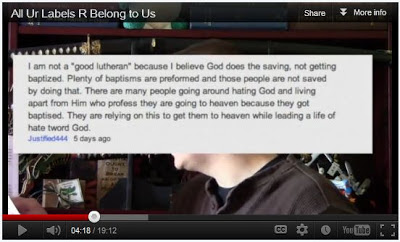


At 4:26, Fisk addresses this.


Here Fisk identifies the problem with Lutheranism, including his definition of Lutheranism.  The problem is one of dishonesty and total lack of integrity.

Notice the statement in the center of this where Fisk replies, saying:


     You are not a Lutheran - which is fine, so long as you are honest about it.


This is a recurring doctrine throughout this video post.  It flows throughout the entire blog and its many posts.

At 5:14 Fisk says in this video,


     Be what you are.  Love what you are.  If you believe something, embrace it. . . . I’m not trying to put you in a hole, I’m just trying to get you to, you know, enjoy what you actually think.  Embrace it!


Is this what the Lord Jesus teaches?  Is this even remotely like what the apostles teach?  Do the Scriptures ever say this?  Or do the Scriptures actually declare that we should hear the truth and be turned from what we are and what we think and what we construct for ourselves?

Do the Scriptures ever declare that it is OK to believe what we want so long as we listen to what others say and accept them for who they are?

Is this the way of the Holy Scriptures?  Is this what is exposed in the “Lutheran Confessions” that Fisk claims to believe and confess and teach?

Do the Lutheran Confessions say that it is OK to love and embrace the ways of Wesleyan Baptist theology and practice?

At 9:12 Fisk says:


     But if your ism happens to be Lutheranism, which basically has six chief things, there’s like six things that make a Lutheran, we call them the six chief parts, and we believe they’re actually six things that make you a Christian, too, although you can be a Christian without believing everything about every piece of the chief parts, but they are the fullness of Christianity and they all point you back to Christ and the cross, but pretty much to deny any of these six things, I mean, it’s not like it’s this big giant list somewhere, it’s six stinkin things, right, you believe these six things and you are a Lutheran.  You don’t believe these six things and you’re not a Lutheran.  We call these six things the Small Catechism, because it is rather small, and catechism means: “teaching.”  It is just the small list of teaching that actually makes you Lutheran.

     I don’t define this.  I mean, where do you get off accusing me of that?  As if it is my idea.  You think I’m making this stuff up?  You think it’s about me?  If you think it’s about me, you just got to watch these videos a lot more, because you know, go back and watch the old ones.  This sucker aint about me man, this sucker’s about the Word of God.


Do people who speak this way ever even listen to themselves so as to hear the amount of double-mindedness that is expressed in their preaching?

For openers, where does Lutheran doctrine ever speak of Lutheran Christianity?

Hmm?

Where do the Lutheran Confessions ever speak of anything other than the one holy catholic/universal/Christian Church?

How can Fisk say, “they’re actually six things that make you a Christian, too, although you can be a Christian without believing everything about every piece of the chief parts”?

How can he say two diametrically opposing things within the same sentence and not hear the fallacy?

How can people listen to this and accept this as genuine?

How can he furthermore refer to the six chief parts of the one true faith by which God’s grace is declared and taught and imparted as “six stinkin things”?

Is this the way of someone whose first thought is to proclaim the truth of God’s Word, or is it the way of someone who is more concerned about sounding cool?

If these six chief parts are what make a person a Christian, how is it possible not to believe everything about them without losing one’s Christianity?

Does a baker accept this notion regarding the ingredients for a cake or a loaf of bread?  Does a mechanic say this regarding the parts of an engine that is being reassembled?  Does an electrician say this concerning the wiring of a house?

Would you trust any of these if they did?

How can Fisk make such statements while demanding integrity and honesty of others?

How can Lutherans in general follow this way as most do today?

The answer rests at least in part with the rest of what Fisk says about these six chief parts.  He says that we call them the Small Catechism.  He makes this false statement because he is falsely focusing upon the “smallness” of the essential and necessary parts of the Christian faith.  He is attempting to minimize the content of the doctrine that must stand as what is believed.

What does Luther and the catholic Church call these six chief parts?

The Catechism, is what they are called.

The so-called Small Catechism is the smaller and more concise of Luther’s explanations of the Catechism.  Luther wrote a Small Catechism in which the six chief parts are briefly explained so that the simple and young could understand them.

Luther also wrote a Larger Catechism in which he expanded his explanations of the Catechism or the Six Chief Parts more extensively.

Something that Luther does not say concerning these six chief parts is that anyone ever may dare to deny them in any part.  To deny these in any way, to reject so as not to believe any portion of these, is to deny the Word of God Himself, to deny Jesus, and to lose one’s salvation.

Luther treats this very seriously.  He never speaks of those who reject the efficacious nature of Baptism as true Christians.  He never speaks of those who deny the body and blood of Jesus in the Sacrament as true Christians.  Rather, he warns them against eating and drinking judgement upon themselves and cutting themselves off from God’s Holy Communion.

But Fisk and nearly every Lutheran today mocks this, saying that a person can be a Christian while denying and refusing to believe what Jesus and His apostles plainly declare.

The Christian faith, the faith by which salvation is imparted by God to those who stand desperately in need of being saved, is an “All or Nothing” faith.  It cannot be divided into portions that are necessary and unnecessary or even less necessary.

As an arborist who climbs trees using ropes for my own positioning and safety as well as for securing and lowering tree limbs and controlling the felling of trees in dangerous situations, I have come to value a saying by Clifford Ashely:


     A knot is never nearly right; it is either exactly right or it is hopelessly wrong, one or the other; there is nothing in between.


This saying is exemplified in the following explanation from “Tie, Dress, and Set (TDS)” in “The Tree Climber’s Companion.”


     Tying knots involves more than just making the “rabbit come out of the hole, go around the tree, and back in the hole” as with the Bowline. A properly tied knot must also be finished properly by dressing it and setting it. Dressing the knot means properly aligning, arranging, or straightening all the parts of the knot so it matches the description and picture in the book. Knot and rope strength can be significantly reduced if the knot is dressed improperly.

     Setting the knot involves tightening all its parts so they properly touch, grab, and press against each other. This creates friction on the rope—the reason a knot works.  A knot that is loosely tied could “capsize” and come untied when a load is applied.  It is good practice to periodically inspect knots while in use to ensure they remain tied.  New knots should never be employed aloft until they can be skillfully tied, dressed, and set (TDS) while on the ground.


From this it is easy to recognize the absolute importance of 100% accuracy in the doctrine of knot tying.  It also is easy to see that one must believe all aspects of this in order for the doctrine to have its effect in practice.

For example, a knot that is tied correctly will not hold if the person does not believe that it must be properly set and therefore skips this absolutely necessary step.

The same is true concerning the Six Chief Parts of Christian doctrine.

No part can be ignored or rejected if the doctrine is to be effective.

God does not give His doctrine without purpose.  He does not teach things that are not necessary.  All aspects of the truth are necessary.  Any departure from the truth is a departure from the truth.

This should be committed to heart, mind and soul.

Any departure from the truth is a departure from the truth.


If one does not hold to this, what difference does it make whether or not one is “honest” about being a Lutheran?  What does it matter if the article of doctrine concerning Baptism can be rejected and one can still be Christian?

The reason that the many imagined Lutherans think that it is important to be Lutheran is that they are actually promoting themselves.

One of Shakespeare’s famous quotations is from Hamlet:

"The lady doth protest too much, methinks."

Lutherans often fall into this category, as Fisk seems to protest too much when he says,

     I don’t define this.  I mean, where do you get off accusing me of that?  As if it is my idea.  You think I’m making this stuff up?  You think it’s about me?  If you think it’s about me, you just got to watch these videos a lot more, because you know, go back and watch the old ones.  This sucker aint about me man, this sucker’s about the Word of God.


If it is not about “being Lutheran,” why do they protest so much?  Why do they not simply proclaim the doctrine of the true faith as absolutely necessary and stand upon this?  Why do they insist on the name of “Lutheranism” and their church bodies?

God says many times and in various ways, both through the ministry of His Son and through the ministry of His apostles, “Baptism saves you.”  (For example: 1 Peter 3:19-21)

If someone says that this is not true, what does that person say of God, of God’s Word, of the Scriptures, of the faith declared in the Scriptures, of the Holy Spirit who inspired men to write these Scriptures, of the men who wrote them and proclaimed them, and of the Church?

If one says that what God says is true but that one can be a Christian while saying that what God says is not true, what does this mean?

Why even bother preaching and teaching concerning these things at all?

Unless of course, it really is about you after all.

Whose word really matters?  In whose words do you really trust?

Hmm?

Romans 3:4

+ + +

Tuesday, October 02, 2012

Ephesians 4 versus “Lutheran Christians”


     It seems that almost anywhere that a person turns in search of those who profess to be Lutherans that a very anti-Lutheran identity is encountered.  It seems that even amongst those claiming to be the most unabashedly Lutheran a very anti-Lutheran identity is professed.

     This term has become very common among those professing to be Lutherans and especially among those who present themselves as “defenders of the faith.”  They commonly refer to the importance of the historic liturgical practice.  They generally refer to the importance of the Lutheran Confessions, even quoting from them, and especially from Luther’s Small Catechism, sometimes from Luther’s Large Catechism, and also even from the Augsburg Confession and the rest of the documents compiled into the Book of Concord.

     Yet even while writing articles and papers regarding the importance of faithfulness to the doctrine and practice tabernacled within these Confessions, even while waxing eloquent in expressing how this doctrine and practice is truly the exposed Word of God as revealed in Holy Scripture, they then apply a term that completely undermines and denounces all that they have written and confessed and proclaimed.

     What is this term?

     Lutheran Christians.

     This self applied identity is anti-Lutheran.  It is, actually, anti-Christian and anti-Scriptural.

     But if one is so bold as to try to explain this to anyone who identifies oneself with this identity and with the identity of one of the larger Lutheran churches, beware!  Stoning could be the result.

     The Lutheran Confessions that the various so-called Lutheran bodies claim to embrace openly and boldly and uncompromisingly declare that such an identity is not of God and not in accord with the Holy Spirit’s revelation of the Word of God through the Scriptures.  In fact, the so-called Lutheran Confessions never even use the term Lutheran.  This came later as people began to depend upon the presumed faithfulness and power of their churches rather than the means of grace.  The use of the name of Lutheran became a way of pretense.  It became an identity that lost its original meaning and became just a trademark or brand of Christianity.

     Today this has become so pronounced that no one really even considers it anymore.  And so pastors and people alike refer to themselves and especially their churches as “Lutheran Christians.”  This is done in an attempt to justify their special niche in the realm of Christendom.  Since it is not counted as loving to proclaim the Scriptural doctrine of One Holy Catholic Church with a clearly defined identity that excludes all who create alternative identities, a very broad and loosely defined Christianity is applied to all, with idiosyncratic attributes and identities to various schismatic groups.  When the term “Lutheran Christians” is used, this schismatic or denominational view is what is being embraced and taught and professed.

     This is anti-Christian.  It is anti-Scriptural.


     I therefore, the prisoner of the Lord, beseech you that ye walk worthy of the vocation wherewith ye are called, With all lowliness and meekness, with longsuffering, forbearing one another in love; Endeavouring to keep the unity of the Spirit in the bond of peace. There is one body, and one Spirit, even as ye are called in one hope of your calling; One Lord, one faith, one baptism, One God and Father of all, who is above all, and through all, and in you all.  (Ephesians 4:1-6)


     Here St. Paul teaches with absolute clarity that there is complete unity in the body of Christ, the Church.  This unity is said to be ONE body.  St. Paul addresses this with extremely strong chastisement to the Church in Corinth.  He plainly teaches them that they have ceased walking as one and that they have created divisions that result in extreme forms of idolatry.  He addresses the Church of God in Corinth, because this is who they were called to be.  A few still remained in that but were allowing divisions or denominations to exist and still be called the Church.  He called them to be turned again together to the true faith and to abide in the way of the truth in absolute unity.

     To the Ephesians the apostle declares that there is ONE body.  This is because there is only ONE Spirit, the very Spirit of God who called them to their vocation as saints in the Communion of God in Christ.  There is ONE body, ONE Spirit, ONE hope.

     He proceeds to explain that there is ONE Lord, ONE faith, ONE baptism.

     There are not multiple Lords who proclaim different doctrines and practices.  No, there is one Lord, who generates us all through one faith in connection with one Baptism.  There are not multiple definitions and confessions of faith.  There are not multiple ways of understanding Baptism and what God works through Baptism, just as there are not multiple Lords or multiple Gods.

     Yet there have been designed and declared multiple bodies and multiple Lords.  Jesus, the Lord, has only one body, yet self-identified Christians have presumed to divide the body of the Lord.  They have divided in their imaginations the Lord Himself.  Some say that 1 Peter 3:21 is not true and is not to be believed, saying that Baptism does not save, while others imagine that the mere action of baptizing apart from the regeneration and renewal of the Holy Spirit can save.  Some say that a person can cause oneself to be “born again” or “regenerated” by one’s own choice and decision rather than being the sole gift and work of God.  Some say that the means of grace are merely symbolic and not actually efficacious.  On and on the variations go.

     Then there are the “Lutheran Christians” who say that they stand apart without standing apart.  They acknowledge those who say that Christ does not mean what He says regarding Baptism and the Holy Communion, saying that they are Christians, but merely erring or misunderstanding Christians.  Yet these divisive alternatives have existed for centuries and those who embrace them do not repent of these so-called misunderstanding even in the face of clear declarations from the Scriptures.

     This being the case, what do “Lutheran Christians” really mean by this term?  What faith are they declaring and confessing and embracing?  What Lord do they confess?  What body do they confess?  What Spirit do they confess?  What Baptism do they administer? What Supper do they administer?

     When a group of Lutheran Christians gather as a body, what body are they?  Within the various so-called Lutheran bodies, often even within the same congregation, there are multiple forms of worship, labeled as Traditional, Less Traditional, Liturgical, Less Liturgical, Contemporary, Rock, Jazz, Praise, and Blended.  These various worship forms and styles teach and practice different understandings of what it means to be the body of Christ.  They create multiple versions of Christianity under the facade of unity.

     This being the case, to what body are they really gathering?  In what body are they trusting that they are the Church?  It is the body that they have created through a corporate charter.  It is a business that markets Christianity under various definitions and forms, but lumping them all together as though the distinctions do not matter.

     This is what enraged the Lord Jesus when He encountered it in the temple courts so that He drove out the marketers of Church from the temple.  But that temple is no more.  Now the Church gathers as one body in various places and times, often as a mere two or three saints who have been drawn together into the name of Jesus through Baptism to partake of the pure means of grace together.  They are gathered not by their own decision or choice, but by the Holy Spirit who leads them to crave that which the Lord has promised and ordained for their everlasting unity and safety in His Holy Communion.

     The big bodies refuse to offer this.  They despise those who count the pure means of grace as the only defining characteristic of the true Church.  The big bodies urge devotion to their corporate structure and define evangelism and the work of the Church as maintaining this identity in the community.  And so they establish internal banking systems such as LCEF, that is, Lutheran Church Extension Fund, and teach people that by using this investment banking system that they are promoting the extension of God’s kingdom through the building of structures upon which signs are erected that declare buildings to be the Church.

     Because people have invested their treasures in these buildings and in the corporations that own these buildings, this becomes their definition of Church.  They then become enslaved to these as their God in which they trust.  Jesus warned that where one’s treasure is, there one’s heart is also.

     Thus people continue to look to their corporations and despise those who humbly and meekly are drawn to gather in unadorned places without pomp and grandeur, simply clinging to the pure means of grace as their identity and hope.

     It is quite common to encounter people who say in response to this, “I do not believe in organized religion.”

     This response is understandable considering the mass hypocrisy that exists throughout Christendom.  Yet this response is illogical, for religion is by definition organized.  The question that needs to be considered is who is the organizer?

     The Scriptures declare a very clearly defined religion.  And yet the Church of this religion is not at all complex.  Neither is it confusing.  Neither is it hard to maintain in unity and purity.  It is defined by its Creator as the gathering or flock or assembly or congregation that the Holy Spirit gathers to the pure preaching of the Word, which produces the pure administration of the Sacraments of Baptism, the Lord’s Supper, and the Confession and Absolution offered in connection with these.  Where these are rightly administered and people gather in humble unity of the faith to receive them, there the Church is.  Here poor and rich, Gentile and Jew, man and woman and child, slave and free, all gather as one and rejoice in God’s goodness together.


+ + +

Wednesday, May 16, 2012

Progressivism in Churches


Disintegration in the churches is an issue that weighs heavily upon my heart and spirit as I observe the secular progressivism encroaching and overtaking the various congregations and church bodies.  As the congregations and church bodies move farther from the apostolic doctrine and practice the churches lose their integrity, becoming more and more loosely defined until their identity becomes blurred with the world.  More and more the people speak of gray areas and uncertainty until in the end, nothing really matters anymore and darkness and disillusionment are all that remain.

I have developed a graphic to illustrate how the bright illumination of the Pure Word and Sacraments becomes less and less visible in the lives of the people, congregations, and church bodies as they move farther away from the historic liturgy and doctrine and practice proclaimed by the apostles.


(for larger view click on graphic)

+ + +

Wednesday, February 29, 2012

Why Are Christians So Hateful?

One of the questions that I sometimes encounter is the question of why Christians are so hateful. Have you encountered that question? Have you asked that question yourself?

The answer to this question may surprise you.

The answer is that they are not. Christians are not hateful.

If in your perception Christians are hateful, consider the following possible explanations.

  • Those whom you are judging as hateful are not really Christians.
  • Those whom you are judging as hateful are being judged according to your own prejudices and hatefulness.
  • You do not understand as clearly as you imagine the actions of those whom you are judging.
  • You do not understand the reasons for the actions that you judge as hateful.
  • The hatefulness that you observed was indeed hateful, but something from which that person or persons would repent if confronted in the name of the Lord and with His Word.
  • Those you judge as hateful are unaware of how their actions affect you or others.
  • Your perception of hatefulness is one that views everyone as hateful, with one possible exception, namely yourself.
  • You hate everyone, including yourself.
  • You have experienced so much hurt in your life that everything and everyone is viewed with fearfulness of being hurt.
  • You really don’t have a clear definition of love.
  • Your definition of love is skewed.
  • You simply don’t like Christians and refuse to admit that they show love in their lives and actions.
  • You have adopted a religious or philosophical or world view that does not allow you to see Christians as loving.
  • You are a hypocrite.
  • You are simply a moron.
  • Various combinations of the above.

The fact is that Christians are not hateful. Many who claim to be Christians are hateful. But Christians are not hateful. Christians are, however, sinners whose lives do have sinful actions. Some of these sinful actions may indeed be hateful actions. But one who is truly a Christian will acknowledge such actions as sinful and wrong and be turned from them through honest confrontation. While a Christian may indeed display a sinful and hateful action, such cannot continue in a Christian. It is not possible. The Epistle of 1 John makes this as plain as it is possible to state the matter. Read it and see.

Thus, if you honestly believe one who professes to be a Christian to be acting contrary to true love, as the Lord Himself defines it through His own sacrificial life and through His Scriptures, kindly address this matter of concern with that person. But don’t make an everlasting fool of yourself by insisting that Christians are hateful or unloving, because the facts are against you.

If you are one who professes to be a Christian and you persistently hear that you are unloving or hateful, consider the source of the accusation. Then examine yourself in the light of the accusation and in the light of God’s Word. Hear the concern for what it is. If it proves to be false, then simply walk away from it and leave it behind. If it is true, then trust the one whom you confess as your God and receive the change of heart and mind that He promises to work in you through His means of grace. Receive His forgiveness and love for yourself, live in it for yourself, and let it pour forth to all whom you encounter in your walk of faith.

Finally, remember that this is a continual event in the life of a Christian. Hearing the Word of the Lord so as to be turned from that which is false and wrong to that which is true and good, namely, Christ and His means of grace in His Church, this is the life of a Christian. True Christians are a rare find. It has always been so. Thus rejoice when you do find one and embrace that one as a brother or sister.

+ + +

Tuesday, February 21, 2012

You Stinking Hypocrite!


Hypocrites, hypocrites everywhere!


This includes my own mirror.

That is, of course, the first place that we each need to acknowledge the reflection of hypocrisy. After turning to the Lord to remove the log from our own eyes, then we see the specks in the eyes of others more clearly. Suddenly what we previously perceived as such an enormous cause for judging others shrinks in our perception.

Certainly there are some monstrous things being perpetrated in the world. But how many of these are actually my responsibility? In a nation where I have a role in the election of those who govern, I do have the obligation to do what I can to be informed. I have an obligation to cry out on behalf of those who are wronged and to cry out for that which is right. But even then, how far does this responsibility extend?

The Lord instructs that my first concern should be regarding my own thoughts, words, and deeds. Then I also am to see to my own family. In this connection I am to judge or discern the Lord’s body so as to be certain that where my household congregates is truly the Lord’s body where His true Communion is. (1 Cor. 11; Matt. 18)

These certainly are sufficient to keep my heart and mind occupied.

But I am not to be like Cain. I am to realize that I am also my brother’s keeper. I am to look beyond myself and my own family and the congregation to which the Holy Spirit gathers us, looking next to those whom I can identify as my brethren in the Lord, and then also to my neighbor. This begins with my prayers to the Lord on their behalf, both generally as in the Our Father, and specifically as I become aware of my neighbor’s personal needs. These prayers for my neighbor will also move me to do what I am able for my neighbor directly. This even extends to issues regarding the city council and eventually even to the vote that I cast for the President of the country.

But when I do these things in honest acknowledgment of all that I observe, I am always back in front of the mirror, being confronted with my own failures, my own sin, and my own hypocrisy, from which I need for the Lord to turn me, directing me again to His grace in Christ. Then, having received his forgiveness I also am empowered to forgive myself. Then I am set free to do the same for everyone else whom I encounter, first forgiving them from my own heart, and then, in that freedom, proclaiming to them God’s forgiveness in Christ.

Imagine what the world would observe if indeed all who professed to believe in Christ actually lived as He has declared. Imagine if this is what the world observed as the way of Christians. Imagine how differently from the current perception even Christians would perceive the Church.

+ + +

Wednesday, February 08, 2012

Simul Iustus Et Peccator - Saint/Sinner Juxtaposition

Simul Iustus Et Peccator means simultaneously saint and sinner.

Throughout my own daily struggles as well as observing the struggles of others who profess to be Christians, I am realizing to a greater and greater degree how hard the struggle over simul iustus et peccator really is. The Saint/Sinner conflict is very much real. Rightly understanding this juxtaposition is very important to understanding the tension of life as a Christian in a fallen world.

This conflict makes it hard to hear so as to be moved to a better understanding of God’s grace to us in Christ Jesus. It hinders us from hearing the clarity of both the Law and the Gospel applied to us so as to move us into the life of the freedom of God’s grace.

This is a universal problem. This is the struggle that all of us Saint/Sinners encounter continually. St. Paul describes this from his own experience as a war within himself. It is a battle that only God can win for us. In fact, He already has, but His victory has to be applied to us in such a way as to make His victory what we realize in our hearts, spirits, and minds, in our total soul/being.

Acknowledgment of the Saint/Sinner juxtaposition is not an excuse for sin, but rather is an explanation for the ongoing struggle that the saints experience in their lives.

We are sinners from our conception because of the separation that Adam chose for us all. There is no escaping this. As long as humans are born into the world this will continue. But God has intervened by being born as the God/Man, Christ Jesus. He took our sin-death and rose from it so that through Baptism we would be regenerated as members of His holiness, made to be communicants of His very body.

The Gospel is the power through which He accomplishes this for us. When the Gospel enters us and enlivens our heart and soul through faith in His mercy and grace in Christ, we are declared to be saints, God’s holies. We are converted from sinner to saint.

But the Old Adam remains in our flesh. The spirit has been freed, but our sinful nature that has been flushed from our spirit still inheres in our flesh. It will remain until our bodies die, or until they are transformed at Christ’s return. Until then, our sinful nature is still at work in our members (our bodily existence).

The Law stands before us and reminds us of this. The Old Adam loves the Law, so long as he is the one wielding it. Then he can use it as he chooses. He loves to tell others that they need to change their abusive ways. But he does not like it when it comes back to himself.

The saint has no use for the Law, except to see God’s holiness and glory. The saint hears the Law and turns away to Christ, confessing sinfulness and the need for forgiveness and healing.

But the sinful nature does not want forgiveness. The sinful nature wants to pretend that it only needs help rectifying one’s wrongs, as if doing better was the goal.

The devil loves this. Then Satan comes forward and shows the saint his sinful nature and continual failing to live in perfect accord with the Law and says: “Ha. You see! You’re not really a saint after all! You’re really just a God damned sinner!”

And according to one’s own actions, one can only despair. For even one’s own conscience makes the same undeniable accusation. This is why the divine service begins with us confessing this very thing.

Seeking to obey the Law cannot make us righteous and cannot lift the burden from us. When we seek to live by the Law, we place ourselves back under the Law.

But when we walk in spirit, our spirit, having been regenerated by the Holy Spirit in our baptism, turns entirely from the Law to Christ and sees His righteousness poured out through His body in the preaching and through His blood in the Holy Supper. In the Supper we actually partake of His body so that we know that we are united with Him in His body and that in His blood His righteousness is given to us as our sins are forgiven us so that we rise up as saints, purely by His grace.

St. Peter explains that through Baptism we are given the good conscience before God so that we may live in His Holy Communion. This is our answer to the Old Adam and to the accusations of the devil and our flesh.

We cannot find peace through attempts at obeying the Law. Such attempts always bind us again to the requirements of the Law. But walking in spirit our spirit hears the continual calling and urging of the Holy Spirit who speaks to our spirit and even calls out on our behalf, Abba! Pater! (Both Hebrew and Greek words for Father).

In this way the Lord gives us the freedom to live in His love. And yes, we see how the Lord has loved us and continues to love us and we then love one another as He has loved us. But we don’t approach this as a goal. We don’t seek this as something to obey. Rather, this is now our identity. We love as the outflow of God’s love at work in us.

But our sinful nature rebels. Our spirit truly desires to love, but the Old Adam rises up in hatred and vengeance. The Old Adam does not forgive his abusers. He wants them to pay. So he drags out the commandments to show that they are guilty. Then he tries to show himself as one who tries to obey. But the Law never loses its capacity to show sin and so the person is again under the Law.

But the Holy Spirit is faithful. He searches the saint’s heart and speaks to the spirit and turns the person again and again to the Gospel, the promise that in Christ we are declared righteous and free. And so the saint eagerly looks to the next offering of the Lord’s body and blood and receives the renewal in God’s grace with a thankful heart. Then love again prevails and the peace of God guards the heart and mind in Christ Jesus.

This is why understanding the Saint/Sinner juxtaposition is the answer to living in love. For when we preach the Law, we realize that we need to hear it first for ourselves, so that we are eager to hear the Gospel. Then, when we preach the Law to others, the Gospel will be our motive with them, too.

Christ is our obedience. He is our righteousness. He is our Life. He is our Love. In Him we are justified and sanctified and converted.

When we seek to make ourselves or others better through the preaching of obedience to the Law, we turn away from the Gospel. But when we preach the Law to ourselves and others as that which shows us God’s holiness which can be ours only through the Gospel, this changes how we perceive and deal with both ourselves and others. It sets us free to live in God’s love and to love by His love.

+ + +

Tuesday, December 20, 2011

Václav Havel's View

I found an article regarding the recently deceased Czech leader, entitled, Living Responsibly: Václav Havel's View, an article that I found very informative and interesting.

Frankly, until today, I was ignorant of this man and his role in the struggle of mankind for knowing the truth and for understanding who we are. I saw some blog posts contrasting this man and the recently deceased ruler of North Korea. This motivated me to study more.

What I learned about Kim Jong-il is horrifying. What I have learned of Václav Havel is truly a contrast.

Two places where I learned of Kim Jong-il and his so-called leadership are: On the Death of A Diabolical Dictator – North Korea’s Killing Fields and Kim Jong-il, North Korean leader, dies. Both of these have videos that reveal the dreadful ways of those who promote themselves as saviors, in the stead of the one who gives Himself as Savior, whose great gift to the world we celebrate Sunday. The videos at “The Guardian” show how powerfully the people of North Korea, or at least the ones shown in the videos, were persuaded by the closed and controlled state media.

Truly the man Václav Havel stands in contrast to this. I find it amazing how American he is, unlike most of us who have enjoyed the freedoms afforded to “real Americans.” He offers a strong warning to America, to Western Civilization, and to the world.

Havel stands as an example of how even one who does not believe in the God who reveals Himself in the Bible can still benefit temporally from the statutes, commandments, precepts, and judgments therein recorded. Havel himself received these temporal benefits, and through his belief in the high morals and ideals many others benefitted as well.

It is sad, though, very sad indeed, to realize that temporal benefits do not equal everlasting benefits. For this man openly declared concerning the rumor that he had become a Christian: “genuine conversion, as I understand it, would mean replacing an uncertain ‘something’ with a completely unambiguous personal God, and fully, inwardly, to accept Christ as the Son of God.… And I have not taken that step.”

This means that he will be standing with Kim Jong-il forevermore. He will not suffer as greatly as the monstrous dictator, but he did reject the life of everlasting blessedness that the Lord Jesus purchased for him.

And this is the so-called Church’s fault. For where would he turn to hear the unadulterated Gospel today? Where would he look to see the holy catholic Church standing in perfect unity of doctrine? Where are the means of grace administered today in accord with Christ’s ordinance? And yet all of these divisive heretics (opinion holders) say that these divisive self held opinion promoters are the Church and are saved. Why then would someone like Havel be inclined to believe in “a completely unambiguous personal God”? From whom would he even hear of such a God so as to believe in Him?

Sadly, frighteningly, poor Mr. Havel is not alone in this confusion that fills the world through the so-called Church of tolerant deviance. When one considers how many victims this view of Christianity claims, who is the more monstrous tyrant, the little ruler of North Korea, or the pastors and other leaders who deny the efficacy of the means of grace and the true unity of the Church of God on earth? And of those who deny the efficacy of the means of grace and the true unity of the Church, who does it most powerfully, those who outright deny that God works salvation through these, or those who teach that they are true means of salvation but then allow that salvation can be received while rejecting them (and thereby the One who ordained them)?

The warning that Mr. Havel spoke to America, to Western civilization, and to the world certainly should be taken seriously by those who call themselves Church. Moreover, if Mr. Havel were able so to do, he would, like the rich man who called out to Abraham in whose bosom Lazarus rested, surely he would call out to the Church unitedly and honestly to warn his brothers concerning who Jesus really is and what Jesus has accomplished for us all.

Christmas, that is, the Christ Mass, is this Sunday. Never mind what this means TO the world. Isn’t it time that Christians first acknowledge what this means FOR the Church so as then also to be able to proclaim what it means FOR the world?

Is it possible that in spite of the infidelity of those who claim to be the Church that somehow, even with the lack of clarity and honesty of their preaching and practice, that somehow the Lord miraculously brought Mr. Havel into the true faith so that he also rests in the bosom of Abraham? This is a question that we have no business asking, for the Lord has nowhere given such a promise. Mr. Havel most certainly could have been converted in his last moments. But this is not our concern. Our concern is that he did not hear it from us! Furthermore, our concern is whether or not we will hear God calling us to repentance ourselves.

Throughout the world people will be singing:

Oh, come, all ye faithful, triumphantly sing:
Come see in the manger our Savior and King!

Where has He promised to be found? Where has He declared His manger to be? How has He said that sinners are to come to Him? Through what means has He said that sinners enter into the kingdom of God? John 3 How does His apostle say that sinners are empowered to be born as sons of God? It is through a decision? Is it through bloodline and heritage? John 1:12-13 How does He say that His blood of forgiveness is given and received? Matthew 26:27-28 Oh that together with one voice and as one true body the Church would gather for the Christ Mass and sing:

To Bethlehem hasten with joyful accord;
Oh, come let us adore Him, Oh, come let us adore Him,
Oh come let us adore Him, Christ the Lord!

+ + +

Wednesday, April 27, 2011

What does being a Christian mean?

The name of Christian, what does it mean? Do you have a clear definition and understanding of this name? How do people define and understand this name?

Luke records in Acts 11:26 that the disciples were first called Christians in Antioch. The term Christian is used again in Acts 26:28 and in 1 Peter 4:16. In Acts 26:28 it is used by an unbeliever, mocking the attempts of St. Paul to explain the faith. In 1 Peter 4:16 it is used with reference to the suffering that the disciples of Christ endure because of this name.

Most people who consider themselves to be Christians today define this name according to what they practice. Most people who consider themselves to be Christian express that being Christian means to believe in Jesus.

In John 8 Jesus defines being His disciples with these words:

As he spake these words, many believed on him. Then said Jesus to those Jews which believed on him, If ye continue in my word, then are ye my disciples indeed; And ye shall know the truth, and the truth shall make you free. (John 8:30-32)

What words did Jesus say to them that moved these hearers to believe on Jesus?

Then said Jesus unto them, When ye have lifted up the Son of man, then shall ye know that I am he, and that I do nothing of myself; but as my Father hath taught me, I speak these things. And he that sent me is with me: the Father hath not left me alone; for I do always those things that please him. (John 8:28-29)

But when Jesus continued to explain to them that they were not free by their own actions and that their believing in Him alone did not set them free, when He explained that knowing the truth is what would set them free, they recoiled and retorted that they were not slaves.

Jesus explained the matter to them more fully. See John 8:28-59.

Those who say that they believe in Jesus today, like those whom Jesus addresses in this text, imagine that they can be true disciples of Jesus without knowing the fullness of the truth that Jesus here explains. Notice what these people did when Jesus expanded their understanding of what they thought that He said.

Jesus said unto them, Verily, verily, I say unto you, Before Abraham was, I am. Then took they up stones to cast at him: but Jesus hid himself, and went out of the temple, going through the midst of them, and so passed by. (John 8:58-59)

How many of those who call themselves Christians today also become angry when confronted with the fullness of what Jesus says? How many today likewise claim that they are not slaves who need to be set free? How many today continue to follow the traditions of their parents and grandparents, remaining in communion with those who attack those who proclaim the truth?

What moved these people to “believe” in Jesus? Interestingly, the text actually says that they believed “into” Jesus. Into what did they enter? What were they trusting and desiring? What did Jesus say that moved them to look to Him as one in whom they desired to believe?

Then said Jesus unto them, When ye have lifted up the Son of man, then shall ye know that I am he, and that I do nothing of myself; but as my Father hath taught me, I speak these things. And he that sent me is with me: the Father hath not left me alone; for I do always those things that please him. (John 8:28-29)

What did they understand from the words, “When ye have lifted up the Son of man”?

Most people today use terms like “sovereignty” and “Lord” and the catch phrase “LordandSaviorJesusChrist.” What it means is the one that they choose to lift up according to what they expect and desire. But when they are challenged to understand what Lord and Savior and Jesus and Christ really mean, especially regarding the fact that they are helpless slaves to their sin and false understanding and pseudo-belief, their displays of “love” and “tolerance” violently turn to displays of anger and rejection.

If you would like to test this, just step into any Lutheran congregation, for example, and explain to those who founded the congregation that their worship and expression of faith is lacking and that their acts of devotion are sinful and that they desperately need God’s forgiveness for their half-hearted faith and love. Tell them with insistence that they need to repent of their devotion to God. Tell them that they need to fall to their knees and receive forgiveness for the sins that they are committing in their worship.

No matter who the congregation is, the Scriptures plainly teach that their worship is sin. The Scriptures plainly teach that all of their righteousnesses are bloody rags. Isaiah 64:6.

And if this is true for those who call themselves Lutheran, what about those who do not even acknowledge the means of grace for what the Scriptures tell us?

Yes, we are slaves of sin, all of us. Even our best actions are corrupt according to our own efforts. All of our righteousnesses, that is, all of our demonstrations of faith and love and devotion, are filth to be cast away. Only by the merits of Christ applied to us in Baptism and in the Holy Supper are we made to be counted as true believers and true disciples of Jesus. This is what the Lord says through His prophets and apostles.

When people truly receive this as the truth, they are set free from all reliance upon themselves and their own reason and strength. Then the testimony that they give is not how Jesus has changed their lives and not upon their sacrifices and actions and devotion and love or even their faith. Rather, their testimony is the mercy of God that is bestowed in and through the pure means of grace. Where this is the testimony of those who gather into the name of Jesus, the name Christian points not to the people, but to the one in whom they trust.


† † †